Last Tuesday, Twitter replaced its appreciation expressor button, pictured as a star, with a heart. Instead of "favs", twitter users will now send "likes" to each other when they want to express that they feel positively disposed towards a 140 character string or its author. Twitter did not change any functionality, but what may look like a tiny typographic change made my timeline extremely angry.
By now (Wednesday), I have seen twitter petitions with thousand of signatures, polls, threats of quitting the social network, and (within the confines of 140 characters) well argued calls for reverting the change. Twitter is "reminding us that our public spaces are privately owned", it "infantilizes communication", it "sacrifices existing users to get new users into the platform", it removes my ability to express appreciation without implying emotional alignment. How could Twitter do such a stupid thing?
Laß die Moleküle rasen, was sie auch zusammenknobeln!
Laß das Tüfteln, laß das Hobeln, heilig halte die Ekstasen
Thursday, November 5, 2015
Wednesday, September 16, 2015
In Defense of Cryonics
The current issue of Technology Review contains Michael Hendricks' scathing condemnation of the proposal of cryonics, i.e. the idea of freezing your body or at least your brain as soon and as rapidly as possible after death, with the goal of being revived in a distant future where technology has progressed to the point where it is possible to do so.
Due to the difficulties of recreating decayed and destroyed tissue, this resurrection might well not be in the flesh, but could involve scanning and recreating the configuration of the brain as closely as possible, using a computational simulation. It is this particular vision that Hendricks argues against.
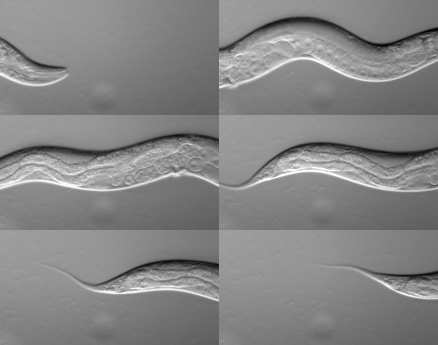
Hendricks is an expert on nematodes, specifically the roundworm Caenorhabditis elegans, which tends to live in soil and feed on decaying organic matter when not spending time in the lab. I can see why Caenorhabditis dislikes the prospect of his food ending up in Alcor's freezer instead of the soil, but the core of Hendricks' arguments is not as compelling to me.
Hendricks makes five especially salient points:
Due to the difficulties of recreating decayed and destroyed tissue, this resurrection might well not be in the flesh, but could involve scanning and recreating the configuration of the brain as closely as possible, using a computational simulation. It is this particular vision that Hendricks argues against.
Hendricks is an expert on nematodes, specifically the roundworm Caenorhabditis elegans, which tends to live in soil and feed on decaying organic matter when not spending time in the lab. I can see why Caenorhabditis dislikes the prospect of his food ending up in Alcor's freezer instead of the soil, but the core of Hendricks' arguments is not as compelling to me.
Hendricks makes five especially salient points:
Thursday, February 5, 2015
How to make Ubena Spaghettigewürz
I grew up in the household of very busy artists, which meant that I had to learn how to cook my own food long before I had the chance to form reasonable ideas about what constitutes a healthy meal. As a result, my favorite dishes include roasted Thuringian potato dumplings, apple rice and crunchily fried spaghetti.
The most important ingredient to fried spaghetti (besides thinly grated gouda) is Ubena Spaghetti-Gewürzmischung.
Saturday, January 31, 2015
Why Artificial Intelligence won't just be a bit smarter than humans
If building human-level Artificial Intelligence is possible, it will mean that we have solved the puzzle of the human mind. Replicating the puzzle pieces artificially and putting them together will not give us a system that is prone to the limits imposed by biological human brains: artificial brains will probably scale much better than biological ones, and our AIs will have more memory, more accuracy, more speed, more ability for integration of mental content, better problem solving capacity, practically infinite attention span and focusing abilities, and so on.
Saturday, January 3, 2015
Jaron Lanier pisses me off
Jaron Lanier's piece on Edge ("The Myth of AI") has sparked quite a bit of discussion in my field, and he really pisses me off. He starts out with a straw man argument, by insinuating that suspect (and dominant, most wealthy!) parts of the tech culture believe that computers were people, and that this would be intrinsically linked to the idea that algorithms were equivalent to life.
I think that is utter rubbish. We may believe that people are computers, and that life is a set of algorithms (i.e., the inverse of what Lanier claims), but we are acutely aware that computers are simply devices for the creation of causal contexts that are stable enough to run software, and for the most part, we do not care about the metaphysics of biological systems.
From Computation to Consciousness
During the 31st Chaos Communication Congress, I had the opportunity to talk about how a computational universe can give rise to consciousness.
(alternate Link)
(alternate Link)
A tale of two machines
How is it possible that we can be conscious of a universe that at the same time computes us? How can we observe the progression of a universe that we are part of? Assuming that our mind is fully embedded into our universe: If the universe would suddenly stop its computations, we could not notice. At every moment, we only exist in a single state. Single states cannot give rise to experience, as any mental process requires a sequence of states (for instance, to retrieve a memory and become aware of its contents).
"Cogito ergo sum" does not work for me: access to and interpretation of the idea that I seem to exist and cogitate in this moment requires a long computational process, which means that I have to introduce additional assumptions beyond the single state the universe offers in the present.
How can we resolve this?
"Cogito ergo sum" does not work for me: access to and interpretation of the idea that I seem to exist and cogitate in this moment requires a long computational process, which means that I have to introduce additional assumptions beyond the single state the universe offers in the present.
How can we resolve this?
Subscribe to:
Posts (Atom)